Hyperlitecoinization
Michiel Bruijn
March 2026

The Gap That Hyperbitcoinization Creates
Daniel Krawisz described hyperbitcoinization as a voluntary transition from an inferior currency to a superior one — a series of individual acts of entrepreneurship that would render fiat money obsolete. He was right. But his essay left a question unanswered: what happens the moment after?
Bitcoin is the superior money. Its fixed supply, its decentralization, its censorship resistance make it the hardest asset humanity has ever produced. Precisely because of this, Bitcoin creates its own paradox during the transition period. The better money becomes, the less people want to spend it. This is not a flaw — it is the logical consequence of holding the best savings technology in history. But it leaves a gap. Commerce still needs to happen. Wages still need to be paid. Coffee still needs to be bought.
Litecoin fills that gap. Not as a competitor to Bitcoin, but as its natural complement — the payment layer to Bitcoin's settlement layer, the silver to its gold.
The Hoarding Paradox
Gresham's Law states that bad money drives out good: when two currencies circulate, people spend the bad one and save the good one. Hyperbitcoinization is Gresham's Law running in reverse — good money displaces bad money until only good money remains. But when the good money is Bitcoin, a second-order effect emerges: people hoard it.
This is already visible. Bitcoin's velocity — the rate at which a unit changes hands — has declined consistently as its monetary premium has grown. Long-term holders increasingly treat their bitcoin as untouchable savings, not as a medium of exchange. This is rational behavior. Why spend something that appreciates in purchasing power?
During hyperbitcoinization this effect intensifies. As fiat collapses, the incentive to hold bitcoin grows stronger still. The economy cannot function on savings alone. A medium of exchange — something people are willing to spend — is needed alongside the store of value. History resolved this tension with gold and silver. The current transition will resolve it the same way.
Block Space Becomes Scarce and Expensive
Bitcoin's block space is finite by design. During hyperbitcoinization, as billions of people transition out of collapsing fiat systems and into sound money, demand for Bitcoin transactions surges. Block space becomes a scarce commodity. Fees rise accordingly.
This is not a bug. High fees signal that Bitcoin's settlement layer is doing exactly what it should: settling large, high-value transactions with finality and security. The Lightning Network extends this capacity for smaller payments, but Lightning requires liquidity, technical setup, and persistent channel management. For the next billion entrants — many of them in developing economies without reliable infrastructure — a simpler, cheaper on-chain alternative is needed during the transition.
Litecoin processes blocks four times faster than Bitcoin. Its fees are a fraction of Bitcoin's even under high demand. It has been running without interruption since 2011 — older than most of the financial infrastructure it is positioned to replace. For the person in Lagos, Buenos Aires, or Beirut who needs to move value today and cannot afford to wait or pay for Bitcoin's block space, Litecoin is the practical choice that does not sacrifice sound money principles.
Silver to Gold — A Historical Template
The gold and silver monetary system was not an accident of history. It was a solution to a real economic problem: gold was too valuable to use for daily commerce. A loaf of bread could not be priced in gold without the coin becoming impractically small. Silver handled the daily economy while gold settled large accounts between merchants and sovereigns.
This two-layer monetary system persisted for millennia across cultures because it matched the natural structure of economic activity. Large, infrequent settlements belong on a hard, scarce layer. Small, frequent transactions belong on a faster, slightly more abundant layer. The layers are not in competition — they are complementary, and each makes the other more useful.
Charlie Lee designed Litecoin explicitly on this model. The 84 million coin supply is four times Bitcoin's 21 million — mirroring the historical silver-to-gold ratio in circulation. The 2.5 minute block time is four times faster than Bitcoin's 10 minutes. These numbers are not arbitrary. They reflect a deliberate architecture: Litecoin as the silver layer of a Bitcoin monetary standard.
Hyperlitecoinization is not Litecoin replacing Bitcoin. It is the silver layer activating alongside the gold layer — the natural completion of a sound money system that Bitcoin alone cannot fully provide.
The Onboarding Ramp
Hyperbitcoinization will not happen uniformly. Different people, in different countries, with different levels of technical sophistication will enter the Bitcoin economy at different times and through different paths. For many, the entry point will not be Bitcoin directly.
Litecoin offers a lower barrier. Transaction fees are accessible. Acquiring small amounts is cheap. The learning curve is identical to Bitcoin — same wallet software, same concepts, same self-custody principles. A person who learns to hold Litecoin securely has learned to hold Bitcoin securely. The habits formed on the silver layer transfer directly to the gold layer.
This is not a detour from hyperbitcoinization. It is a wider road toward it. Capital that enters via Litecoin does not stay in Litecoin — it gravitates toward the superior store of value once the holder understands the difference. The onboarding ramp and the destination are not the same place, but one leads to the other.
Litecoin as Bitcoin's Proving Ground
Segregated Witness was activated on Litecoin months before Bitcoin. The Lightning Network was tested on Litecoin first. The first cross-chain atomic swap — the technical foundation for trustless exchange between two blockchains — was executed between Litecoin and Bitcoin in 2017. MimbleWimble Extension Blocks, which bring optional transaction privacy, were deployed on Litecoin in 2022.
This pattern is not coincidence. Litecoin's role as a live, production testnet for Bitcoin-adjacent technology means that the entire ecosystem benefits from its existence. Features that would be too risky to deploy directly on Bitcoin's base layer are proven on Litecoin's slightly more forgiving proving ground, then adopted by Bitcoin when the technology is mature.
During hyperbitcoinization, when the pace of technological development must match the urgency of monetary collapse, this role becomes more valuable, not less. The innovations that Bitcoin will need to serve billions of people will be tested somewhere first. That somewhere is Litecoin.
Hyperlitecoinization
Hyperbitcoinization is the demonetization of fiat — the collapse of state-controlled money under the competitive pressure of a superior alternative. It will happen, is already happening, faster than most expect.
But the world that emerges from hyperbitcoinization is not a world where one asset serves every monetary function simultaneously. It is a world with a monetary architecture — a hard, scarce, savings layer and a faster, practical payment layer — built on the same sound money principles and interoperable by design.
Hyperlitecoinization is not a separate event. It is what happens within hyperbitcoinization, as the monetary system that Bitcoin makes possible completes itself. Bitcoin is the foundation. Litecoin is the floor you walk on.
No one will notice the moment it happens. That is how it is supposed to work.
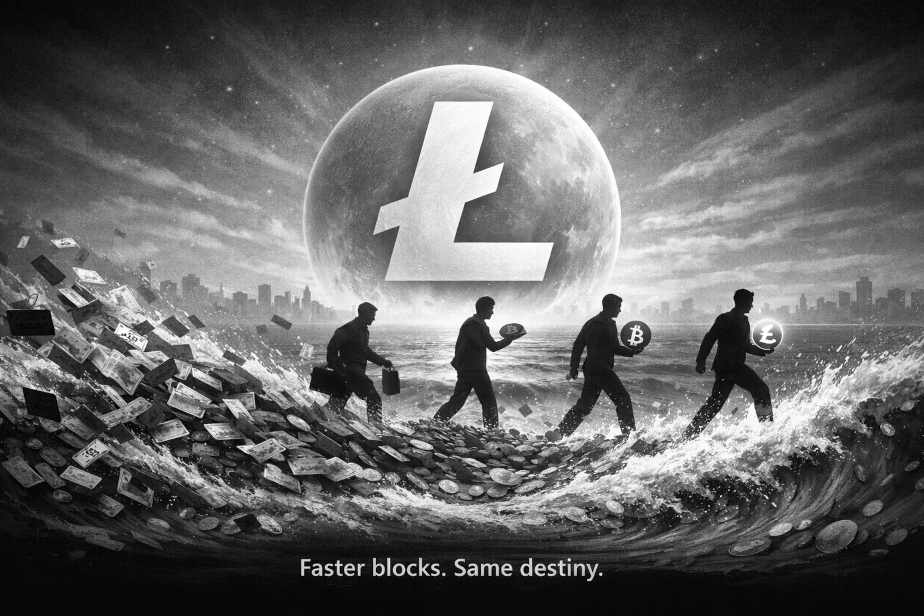
(Original artwork by the author)
A companion essay to Hyperbitcoinization by Daniel Krawisz (2014)
Support this essay
ltc1qfpy3d3c4q33kuu5engg6dsujvwfhfdt46k0x6d
Litecoin (LTC)